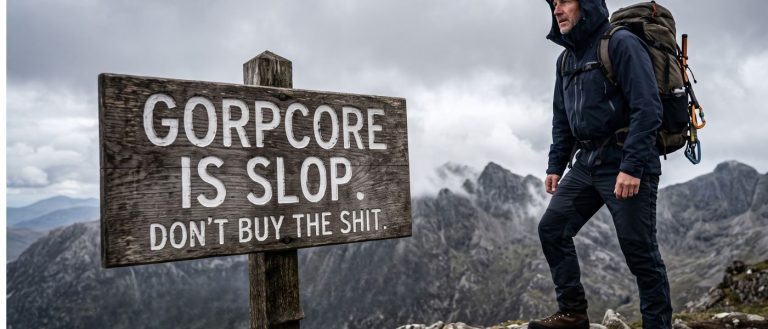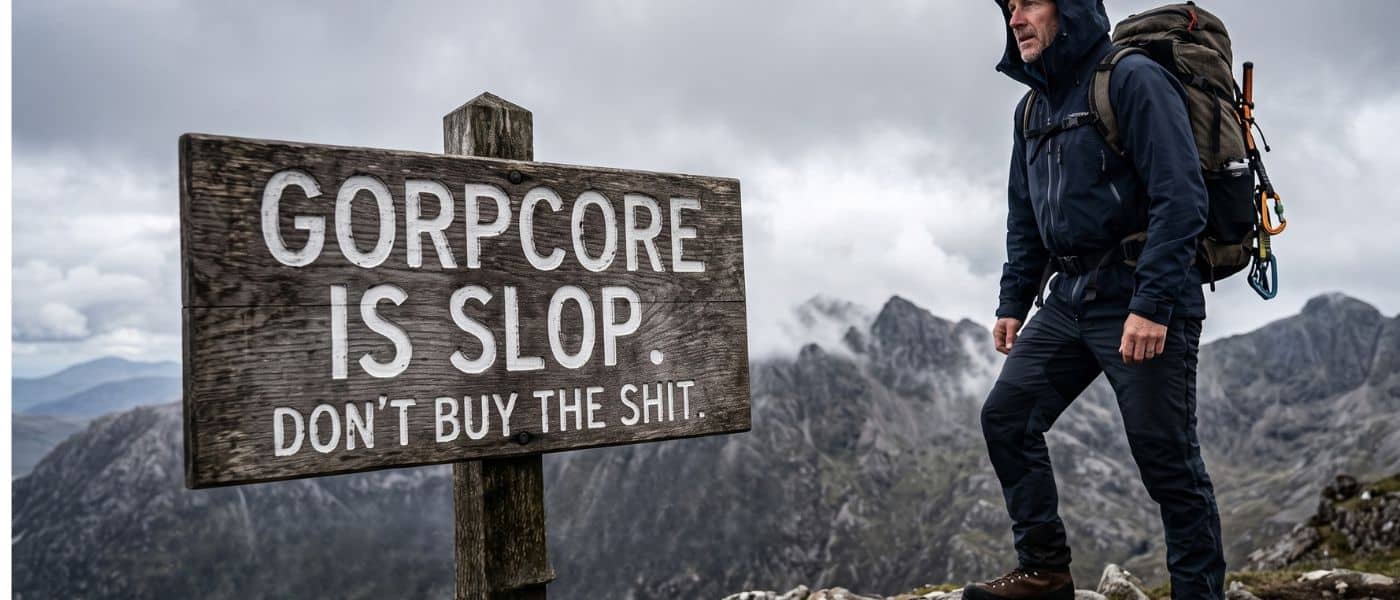
What is Gorpcore, and why is it failing real outdoor adventurers?
Gorpcore is the fashion trend of wearing high-performance technical outdoor gear—like Gore-Tex shells, trail runners, and down parkas—as casual streetwear. While it makes city dwellers look ready for the hills, it has motivated big apparel brands to churn out “outdoor slop”: mass-produced, aesthetic-first gear that sacrifices durability, real weatherproofing, and functional safety for profit margins and street style. Think black puffer jackets.
Why Gorpcore “Slop” Is Trapping Adventurers
When you are three miles off-grid, soaking wet, and the temperature drops toward freezing, your jacket (all of your gear, jackets, mid-layers, trousers, hiking boots, backpack, kit in backpack etc) isn’t a fashion statement—it’s life support.
Yet, walk into any high-street retailer today and you’ll find rack after rack of “outdoor gear” designed not for alpine ridge lines, but for coffee runs and Instagram feeds. This is the era of Gorpcore—a trend named after the classic hiking snack “Good Old Raisins and Peanuts”—and it is quietly ruining technical outdoor kit. It’s like buying a Land Rover Defender OCTA to do the school run in the city.
Driven by massive profit margins, major outdoor brands are increasingly producing outdoor slop: watered-down, visual imitations of real expedition gear. They wrap fashion-grade textiles in taped seams and slap premium price tags on them, banking on the fact that 90% of their buyers will never step foot in the outdoors.
If you actually go out into the wild, trusting your life to fast fashion posing as technical kit, it could be one of the most dangerous mistakes you could make. But we are here to educate you and save you from such a blunder.
Technical Kit vs. Gorpcore Slop: The Differences That Matter
When real weather hits, the difference between genuine alpine kit and fashion-focused outerwear becomes obvious immediately.
| Feature | Genuine Technical Gear | Fast-Fashion “Gorpcore” Slop |
| Waterproof Membrane | True 3-layer Gore-Tex Pro or proprietary membrane (20,000mm+ hydrostatic head) | Cheap 2-layer PU coatings that wet-out in 20 minutes of heavy rain |
| Fabric Durability | High-denier ripstop Cordura/Nylon built to resist rock abrasion | Thin, low-grade polyester prone to tearing on brush or rock |
| Seam Construction | Micro-taped, high-density stitching optimised for mobility | Wide, sloppy seam taping that delaminates shortly after purchase |
| Fit & Mobility | Articulated knees/elbows designed to layer over mid-layers | Boxy, street-style cuts that pull up and expose skin when reaching |
| Safety Features | Integrated RECCO reflectors, storm hood adjusters, glove-friendly pulls, retro-reflective decals and more | Decorative zippers, non-adjustable hoods, zero safety integration |
Why Big Brands Switched from Performance to “Outdoor Slop”
The shift isn’t an accident—it’s a business model, it is profit margins!!
Massive Margins on Lower Specs: Manufacturing a true 3-layer, fully featured alpine shell is expensive. Manufacturing a lightweight, 2-layer polyester jacket with trendy color blocking costs a fraction of the price, yet brands can charge near-expedition prices because of logo placement.
The Urban Majority: The vast majority of consumers purchasing technical outerwear today will never use it outside city limits. Brands know that a jacket only needs to survive a rainy commute, not a night bivouacked on a ledge.
Designed to Fail (and be Replaced): True expedition kit lasts decades. Fast-fashion gorpcore uses delicate face fabrics and cheap DWR (Durable Water Repellent) coatings that degrade rapidly, forcing consumers into a yearly replacement cycle.
How to Spot Fake Outdoor Kit Before You Buy It
Before you buy kit for your next hike, clear away the marketing hype and inspect the build quality:
Check the membrane specs: Real technical shells explicitly state their hydrostatic head ratings (look for 15,000mm or higher) and breathability scores (MVTR). If a brand hides these numbers, it’s lifestyle wear.
Inspect the denier count: Look at the fabric density (e.g., 40D to 80D nylon). If it feels like a disposable windbreaker, it won’t survive a scramble through granite country or heavy bushes.
Test the hood and cuffs: Real storm hoods cinch tight around your face with single-handed toggles and feature structured, wired brims that keep rain out of your eyes. Fashion hoods flop flat against wind.
Look at the zipper construction: Alpine gear uses heavy-duty, water-resistant YKK AquaGuard zippers with internal storm flaps. Cheap fashion kit uses standard plastic teeth that leak under pressure.
Gorpcore Conclusion
Stop feeding the machine. When you buy fashion-first “gorpcore” slop, you aren’t just risking your comfort and safety in the outdoors—you’re actively funding the demise of high-performance technical gear. Every pound spent on watered-down street style gives big brands a reason to slash quality, cut corners, and prioritiae corporate profit margins over survival-grade innovation.
Do yourself a favour: ditch the trend, demand real performance, and invest in kit that actually holds up when the weather turns ugly.
For honest, field-tested reviews of true technical gear you can actually trust your life to, read our review here at bestoutdoors.co.uk.
Frequently Asked Questions
Is Gorpcore gear okay for day hiking?
Most people will say that for mild, predictable weather on well-maintained trails, fashion-leaning outdoor gear is fine. However, we say, NO. Do not get into a habit of taking the wrong gear to the outdoors. Stop before you even start.
Why is Gore-Tex on cheap jackets not working like it used to?
Many lower-tier lifestyle jackets use 2-layer Gore-Tex designs paired with eco-DWR finishes that require constant re-proofing. Without high-denier face fabrics, the outer material quickly saturates with water (“wets out”), trapping sweat inside and making you cold.
How can I support brands that still make real adventure gear?
Look past mass-market high-street brands and research independent, specialised manufacturers who publish exact fabric specifications, offer lifetime repair programs, and design specifically for alpine environments rather than urban streetwear trends.