
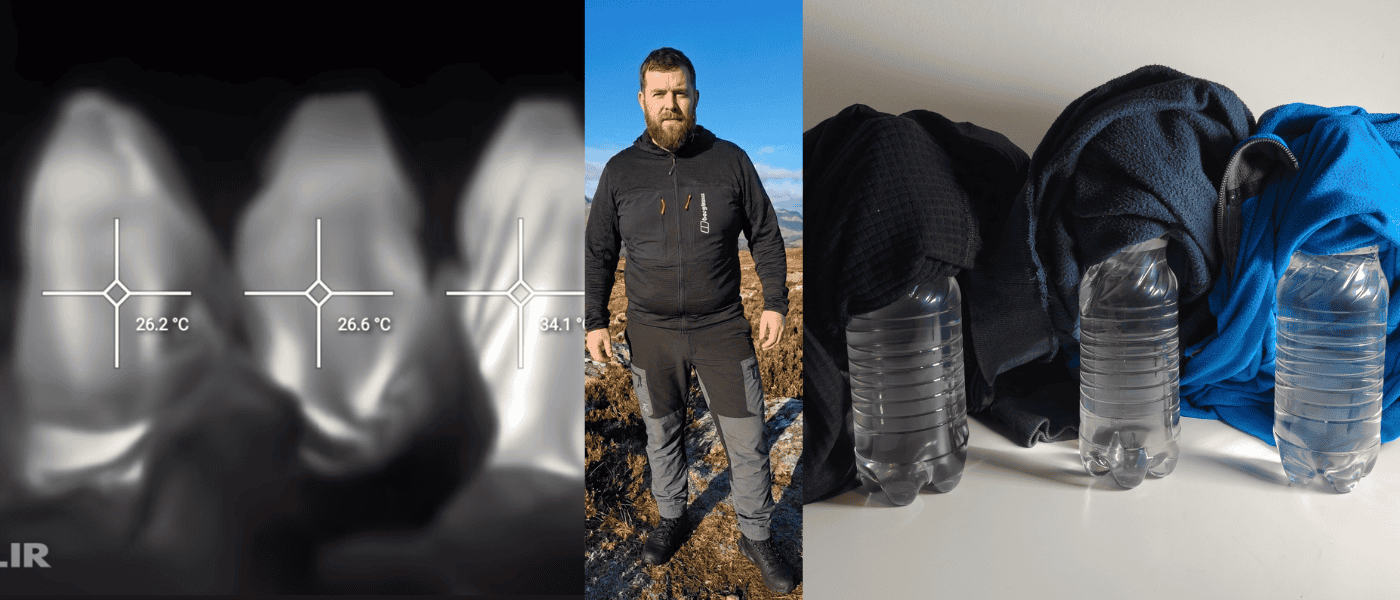
The mid-layer category is crowded with jargon, promises, and huge price variations. Jackets marketed as technical mountain gear. So when Berghaus sends you something from their AW26 Extrem Range we thought, lets test. To separate marketing claims from performance reality, we tested the Berghaus MTN Guide Hoody against two common alternatives: a RevolutionRace Trekker Fleece (a great lightweight fleece) and a standard cotton/polyester everyday hoodie in our office lab. (Lab maybe a push to far)
Using standardised thermal cores and thermal imaging from a Ulefone Armor Mini 20T Pro FLIR camera, we tracked heat retention, conductive thermal bleed, and post-exposure residual temperatures over a two-hour indoor bench test. The results demonstrate why technical fabric architecture matters when heading into demanding environments like the Scottish Highlands in winter.
Note: The Berghaus MTN Guide Hoody is part of the Berghaus AW26 Extrem Range Built for High Alpine Ascents & Sub-Zero Mountain Days.


The Test Methodology
- Thermal Core: Three identical containers filled with water stabilised at 50.0°C.
- Insulating Enclosures: Sleeves from each garment wrapped around the bottles under identical indoor ambient conditions.
- Thermal Imaging: A calibrated FLIR thermal camera recording garment exterior temperatures across set intervals.
- Direct Core Checks: Garments were peeled back at 21:24 and 22:02 to directly image the bare container exterior, followed by a final core check at 22:03 and fabric residual checks at 22:05.
Core Container Temperature Trajectory:
Start (20:00):      50.0°C (All)
Bare Check (21:24): Berghaus: 41.4°C | Hoodie: 40.9°C | RevolutionRace: 41.5°C
Bare Check (22:02): Berghaus: 37.4°C | Hoodie: 36.7°C | RevolutionRace: 37.1°C
Final Core (22:03): Berghaus: 36.5°C | Hoodie: 36.2°C | RevolutionRace: 36.1°C
Thermal Camera Findings: Heat Leakage vs. Dead-Air Retention
| Timestamp | Measurement Window (1min) | Berghaus MTN Guide (°C) | Casual Hoodie (°C) | RevolutionRace Trekker (°C) | Measurement Focus |
| 20:00 | Start → Finish | 26.0 → 25.9 | 27.0 → 26.5 | 30.0 → 35.7 | Sleeve exterior |
| 20:10 | Start → Finish | 27.7 → 28.4 | 27.6 → 30.7 | 29.5 → 39.2 | Sleeve exterior |
| 20:30 | Start → Finish | 24.1 → 25.1 | 36.2 → 28.6 | 30.1 → 35.3 | Sleeve exterior |
| 21:18 | Start → Finish | 25.2 → 25.2 | 25.9 → 26.6 | 28.4 → 28.9 | Sleeve exterior |
| 21:24 | Intermediate Check | 41.4 | 40.9 | 41.5 | Bare bottle surface |
| 21:29 | Start → Finish | 27.3 → 26.1 | 25.7 → 25.7 | 25.8 → 25.6 | Re-wrapped exterior |
| 21:57 | Start → Finish | 23.9 → 24.5 | 24.3 → 25.2 | 25.9 → 26.0 | Re-wrapped exterior |
| 22:02 | Secondary Check | 37.4 | 36.7 | 37.1 | Bare bottle surface |
| 22:03 | Final Core | 36.5 | 36.2 | 36.1 | Core bottle temperature |
| 22:05 | Residual Heat | 23.9 | 24.3 | 25.9 | Fabric residual heat |
Key Data Insights
1. Lowest Conductive Thermal Leakage
- The RevolutionRace Trekker suffered severe outward heat bleed, climbing from 30.0°C up to 35.7°C in the first window and peaking at 39.2°C at 20:10. That heat was escaping directly into the surrounding air.
- The Casual Hoodie showed significant thermal bridging, spiking up to 36.2°C at 20:30 where the knit pulled tight against the bottle wall.
2. Superior Core Heat Retention Over Time
- By 22:02, the Berghaus core held at 37.4°C, ahead of the RevolutionRace (37.1°C) and the hoodie (36.7°C).
- At the final 22:03 reading, the Berghaus preserved the warmest core at 36.5°C, compared to 36.2°C for the hoodie and 36.1°C for the RevolutionRace.
3. Residual Heat Storage: Mass vs. Dead Air
- Berghaus: 23.9°C (cooled down nearest to ambient room temperature)
- Casual Hoodie: 24.3°C
- RevolutionRace: 25.9°C
Berghaus MTN Guide Hoody: Thermal Performance Analytics
Controlled bench test tracking conductive outer thermal leakage, core water temperature decay, and post-exposure residual garment heat compared to the RevolutionRace Trekker Fleece and an everyday casual hoodie.
Graph 1: Garment Exterior Surface Heat Leakage (°C)
Sleeve exterior FLIR reading. Lower temperatures mean better thermal insulation (less conductive bleed).
Graph 2: Core Bottle Water Temperature (°C)
Measured direct core decay over 2 hours. Higher is better.
Graph 3: Peak Heat Bleed vs. Residual Fabric Temp
Comparing worst-case heat leakage against post-test fiber heat retention.
Complete Benchmark Log
| Time | Measurement Type | Berghaus MTN Guide | Casual Hoodie | RevolutionRace | Advantage |
|---|---|---|---|---|---|
| 20:00 | Exterior Sleeve | 26.0°C → 25.9°C | 27.0°C → 26.5°C | 30.0°C → 35.7°C | Berghaus |
| 20:10 | Exterior Sleeve | 27.7°C → 28.4°C | 27.6°C → 30.7°C | 29.5°C → 39.2°C | Berghaus |
| 20:30 | Exterior Sleeve | 24.1°C → 25.1°C | 36.2°C → 28.6°C | 30.1°C → 35.3°C | Berghaus |
| 21:18 | Exterior Sleeve | 25.2°C → 25.2°C | 25.9°C → 26.6°C | 28.4°C → 28.9°C | Berghaus |
| 21:24 | Bare Bottle Check | 41.4°C | 40.9°C | 41.5°C | Tied (RR/Berghaus) |
| 21:29 | Exterior Sleeve | 27.3°C → 26.1°C | 25.7°C → 25.7°C | 25.8°C → 25.6°C | Equilibrating |
| 21:57 | Exterior Sleeve | 23.9°C → 24.5°C | 24.3°C → 25.2°C | 25.9°C → 26.0°C | Berghaus |
| 22:02 | Bare Bottle Check | 37.4°C | 36.7°C | 37.1°C | Berghaus |
| 22:03 | Final Core Water Temp | 36.5°C | 36.2°C | 36.1°C | Berghaus |
| 22:05 | Residual Fabric Heat | 23.9°C | 24.3°C | 25.9°C | Berghaus (Fastest shed) |
Practical Scottish Winter Mountaineering Applications
- Sustained Ascent Venting: The grid channels between the Berghaus fleece tufts act as micro-chimneys. When working hard up steep terrain with shell vents open, moisture vapor exhausts freely. Dense fleeces like the RevolutionRace trap that heat internally until you soak through with sweat.
- Belays & Stagnant Stops: The test demonstrated that the Berghaus has the lowest exterior thermal bleed. Once an outer shell cuts off wind penetration, the Berghaus locks dead air against your core, keeping you warmer than heavier, denser fleeces.
- The Wet Hazard: A cotton hoodie absorbs water like a sponge and, as shown by its erratic hot spots, creates direct thermal bridges that rapidly drain body heat. In damp Scottish conditions, cotton remains a severe hypothermia risk. The hydrophobic synthetic fibres of the Berghaus hold negligible water weight and dry quickly using body heat alone.
Garment Comparison Summary
| Attribute | Berghaus MTN Guide Hoody | RevolutionRace Trekker | Casual Cotton/Poly Hoodie |
| Insulation Technology | Technical Polartec Power Grid | Continuous Brushed Fleece | Dense Knit Cotton/Polyester |
| Peak Exterior Surface Temp | 28.4°C (Lowest leakage) | 39.2°C (Highest leakage) | 36.2°C (Inconsistent bridging) |
| Final Core Temp (22:03) | 36.5°C (Warmest) | 36.1°C (Coolest) | 36.2°C |
| Residual Heat (22:05) | 23.9°C (Fastest release) | 25.9°C (Holds heat in mass) | 24.3°C |
| Scottish Winter Verdict | Essential active mid-layer | Casual camp/low-output piece | Unsuitable for mountain use |
Why Low Conductive Thermal leakage is Important
In cold, wet environments—such as maritime winter mountains—heat moves away from your body primarily through conduction and evaporative/convective transfer.
Conductive thermal leakage measures how readily a textile allows heat energy to pass directly through its physical fibres to the outer face. When that rate is low, the garment traps heat internally. When it is high, it creates severe cascading risks across the rest of your layering system.
1. Water Amplifies Conductive Loss by 24×
Still air is one of nature’s best thermal insulators, with a thermal conductivity of roughly 0.026 W/(m·K). Pure liquid water, by contrast, has a thermal conductivity of roughly 0.6 W/(m·K)—about 24 times higher.
When a fabric has high conductive leakage, it relies on dense fibre mass rather than stable dead-air voids.
In freezing drizzle, sleet, or heavy fog, moisture settles into the outer face of the garment.
If heat conducts easily to that damp outer layer, water replaces the trapped air pockets, turning your mid-layer into a literal thermal highway that drains metabolic heat straight out of your body.
2. Preventing Internal Shell Condensation (The Dew Point Problem)
In a three-layer system (Base Layer >Mid-Layer > Waterproof Hard Shell), your hard shell sits at roughly the outside ambient temperature (e.g., 0°C).
Body (37°C) ──> [Base] ──> [Mid-Layer] ──> Cold Air Gap ──> [Hard Shell (0°C)] ──> Outside
                               ▲
                 LOW LEAKAGE: Surface stays ~15-20°C
                 Result: Moisture leaves as vapor before hitting cold shell
High Conductive Leakage: The mid-layer pushes heat and sweat vapor directly against the inner face of the hard shell membrane. When warm, humid air hits a freezing laminate, the vapor immediately condenses into liquid water inside your shell. You soak from the inside out.
Low Conductive Leakage: A mid-layer with low conductive transfer (like a lofted Polartec grid) creates a gradual, buffered temperature gradient. It vents moisture as free vapor while holding heat close to the skin, preventing rapid internal saturation against your outer shell.
3. Preserving Heat During Inactive Transitions
In mountain conditions, the most dangerous period is transitioning from high-output movement (uphill slog) to static rest (belaying, navigating a windy col, or eating lunch).
On the move: Your muscles generate 300–600 W of heat, easily compensating for poorly insulated, leaky clothing.
At rest: Heat output drops back down to ~80–100 W.
A mid-layer with low conductive leakage stops the sudden drop in core temperature the second you stop moving. Because it does not conduct body heat freely to the outer environment, it holds onto that hard-earned core warmth instead of dumping it into the freezing ambient air within 10 to 15 minutes.
4. Preventing the “Sensible Heat Trap”
Denser, non-technical fabrics often feel warm in the shop because they absorb and hold thermal mass (sensible heat storage). However, in wet cold:
Heavy fabrics that store heat internally require massive amounts of energy to dry once damp.
Fabrics with low conductive leakage via high-loft air voids (like Polartec Power Grid) store virtually zero heat in the fibers themselves. They isolate you using trapped air, shed absorbed moisture rapidly, and dry out using minimal metabolic energy.
System Summary
| Metric / Behavior | Low Conductive Leakage (Technical Grid/Loft) | High Conductive Leakage (Dense Fleece / Cotton) |
| Primary Insulation | Trapped, non-moving dead air voids | Fiber mass / physical textile bulk |
| Heat Loss in Damp Air | Minimal; moisture stays outside dead-air zones | Rapid; water bridges fibre gaps and drains warmth |
| Shell Compatibility | Reduces interior condensation and sweat buildup | Causes severe sweat condensation inside hard shell |
| Belay / Rest Survival | Core temperature stabilises quickly | Rapid core cooling; severe shivering reflex within minutes |


